Expert VA Disability Law Firm

VA Disability Benefits Explained

Not sure what VA disability benefits you may qualify for or how they work? This resource breaks down the different types of VA disability benefits in clear, straightforward language—explaining who’s eligible, how each benefit works, and what you need to apply. You will also learn how factors like your disability rating, dependents, and work history can impact what you receive. Click on each item to view a detailed breakdown of the specific benefit.

Special Monthly Compensation Based on Aid & Attendance (A&A) Explained

The general rating criteria for VA disability evaluations range from 0-percent to 100-percent. However, VA recognizes that even a 100-percent disability evaluation may not fully capture a veteran’s disability picture. As a result, veterans may be entitled to compensation at levels in excess of 100-percent, called Special Monthly Compensation (SMC). One of these levels of SMC is based on a veteran’s regular need for aid and attendance as a result of the veteran’s service connected disabilities.

Bottom Line Up Front:
 
  • Entitlement to SMC based on aid and attendance is granted when VA establishes a veteran is in regular need of aid and attendance from another person due to their service-connected disabilities

  • VA Form 21-2680, Examination for Housebound Status or Permanent Need for Regular Aid and Attendance, can provide VA with the medical evidence necessary to support a claim for A&A.

  • Important to Know: The standard is regular aid and attendance. It does not require constant, round-the-clock care. It also does not require a professional healthcare provider. The A&A can be provided by a spouse, other family member, friend, or hired help, etc.

What is Special Monthly Compensation based on Aid and Attendance?

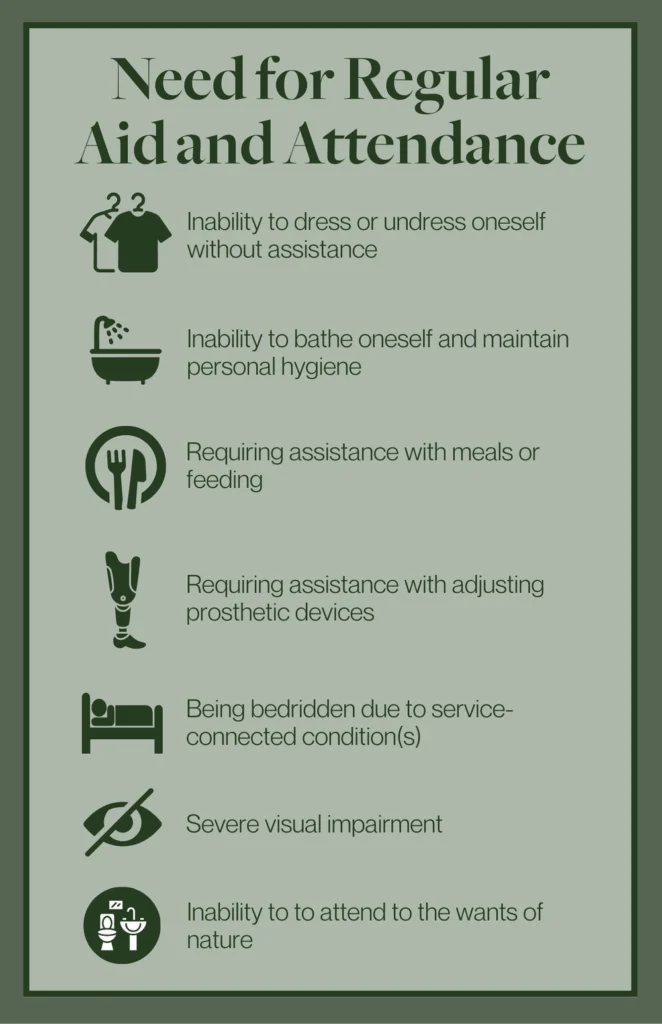
A&A is governed under 38 C.F.R § 3.352(a). The following will be accorded consideration in determining the need for regular aid and attendance:

  • inability of claimant to dress or undress himself (herself), or to keep himself (herself) ordinarily clean and presentable;
  • frequent need of adjustment of any special prosthetic or orthopedic appliances which by reason of the particular disability cannot be done without aid (this will not include the adjustment of appliances which normal persons would be unable to adjust without aid, such as supports, belts, lacing at the back, etc.);
  • inability of claimant to feed himself (herself) through loss of coordination of upper extremities or through extreme weakness;
  • inability to attend to the wants of nature;
  • or incapacity, physical or mental, which requires care or assistance on a regular basis to protect the claimant from hazards or dangers incident to his or her daily environment.
Developing A&A Claims
  • The form includes Section VI, Examination Information, which must be filled out by an examiner (i.e. a medical professional).

  • It addresses which disabilities are permanent in nature and require regular aid and attendance.

  • It asks which service-connected disabilities the patient requires assistance with, e.g. bathing/showering, eating, dressing, tending to hygiene needs, etc.

  • It also asks questions regarding the patient’s competency and ability to leave the house.

  • Lay statements can be helpful evidence because they can speak to firsthand knowledge of the veteran’s daily requirements for assistance.

  • Helpful lay statements would be obtained by family members, caretakers, and friends who can speak to witnessing a veteran’s need for aid and attendance, or even assisting them firsthand.

  • They can discuss the chores and assistance friends, family, and caretakers provide for the veteran.

  • The statements can also speak to the frequency of people assisting the Veteran on a daily, weekly, or monthly basis.

How to Appeal a Denied A&A Claim

If VA denies entitlement to Special Monthly Compensation (SMC) based on aid and attendance, veterans may appeal through:

  • Supplemental Claim (with new and relevant evidence)

  • Higher-Level Review

  • Board of Veterans’ Appeals

Because SMC claims involve statutory interpretation, medical causation, and specific rules, professional representation can significantly improve outcomes.

Looking for More Information?

Check out our YouTube video where VA-Accredited Claims Agents Vittoria Marini and John Kent sit down with VA-Accredited Attorney Courtney Ross to break down Special Monthly Compensation based on the need for Aid & Attendance.

Denied A&A or Unsure If You Qualify? Call Greene & Marusak LLC

A&A claims are among the most complex areas of VA law. Veterans often face denials that overlook critical evidence or misapply the law.

If VA denied your A&A claim—or you are unsure whether you qualify—Greene & Marusak LLC can review your case and explain your options.

Contact us for a free case evaluation today to speak with an experienced VA-accredited claims agent or attorney.

Dependency and Indemnity Compensation (DIC) Explained

Dependency and Indemnity Compensation (DIC) is a tax-free monthly benefit paid by VA to eligible surviving spouses, children, and sometimes parents of veterans whose death was caused by or related to service. DIC claims often involve complex legal and medical questions, including cause of death, service connection, and VA’s duty to properly apply the law. Because these cases arise after a veteran has passed away, clear evidence and strategic advocacy are especially important.

Bottom Line Up Front:
  • DIC is payable when a veteran’s death was caused by a service-connected condition or when the veteran was rated totally disabled for a qualifying period before death.

  • Medical records, death certificates, nexus opinions, and lay evidence can be critical to establishing entitlement to DIC.

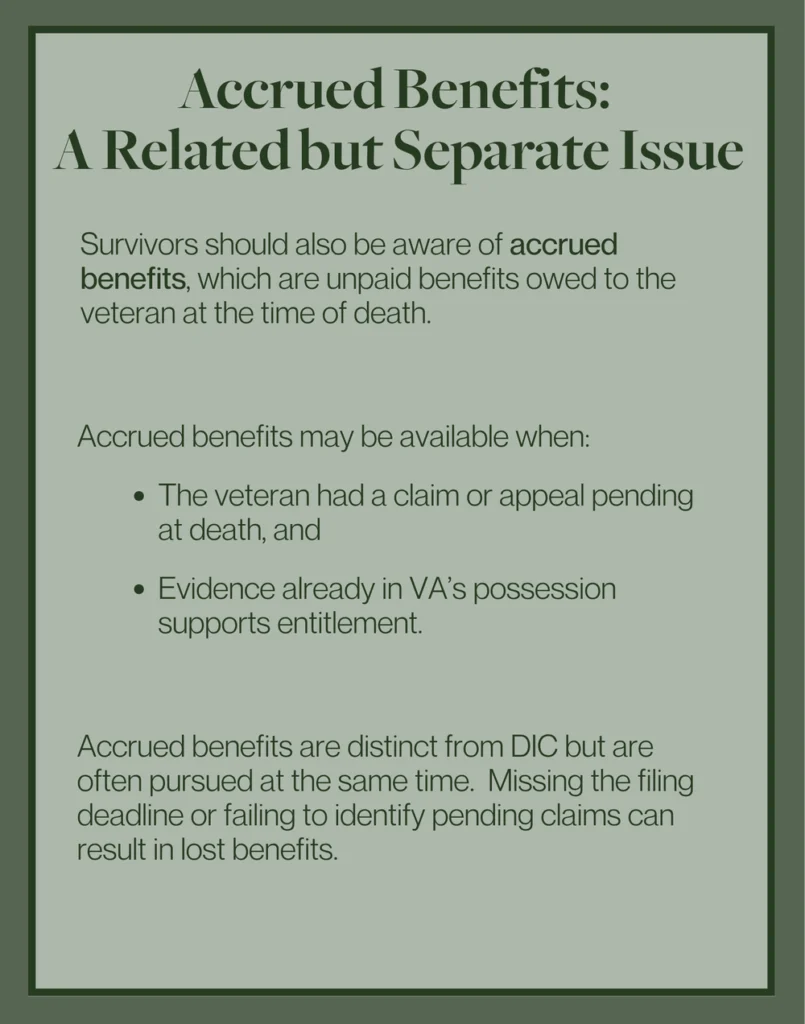
  • Survivors may also be entitled to accrued benefits for claims or appeals pending at the time of the veteran’s death.

What is Dependency and Indemnity Compensation?

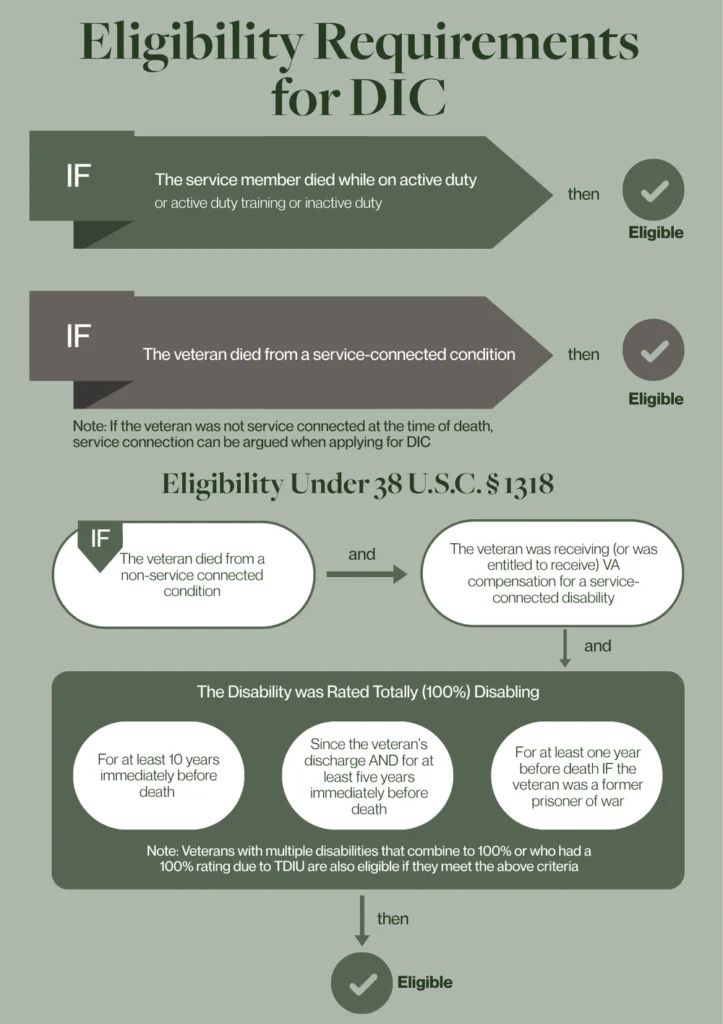
DIC is governed primarily by 38 U.S.C. §§ 1310 and 1318 and provides monthly compensation to eligible survivors when:

  • A veteran died from a service-connected disability, or

  • A service-connected disability contributed to death, or

  • The veteran was rated 100 percent disabled (including TDIU) for a required period prior to death, even if the cause of death itself was not service-connected.

Unlike disability compensation, DIC is a fixed monthly benefit and does not increase or decrease based on symptom severity. Instead, qualification depends on meeting specific legal requirements and establishing a connection between service, disability, and death. Increases may only happen on an annual basis based on federal cost of living adjustments (COLA).

Who is Eligible for Dependency and Indemnity Compensation?

A surviving spouse may qualify if:

  • They were married to the veteran at the time of death, and

  • They lived continuously with the veteran (with limited exceptions), and

  • They did not remarry before age 57 (with certain statutory exceptions).

Unmarried children may qualify if they are:

  • Under age 18,

  • Between 18–23 and attending school, or

  • Permanently incapable of self-support before age 18.

In limited cases, dependent parents may qualify based on financial need.

How VA Determines Entitlement to DIC

The most common basis for DIC is when:

  • A service-connected disability was the principal cause of death, or

  • A service-connected condition contributed substantially or materially to death.

Evidence VA considers includes:

  • Death certificates

  • Terminal hospital records

  • Autopsy reports

  • Treating physician opinions

  • VA and private medical records

  • Lay statements describing symptoms, decline, or complications prior to death

A condition does not need to be the sole cause of death. It is enough if it accelerated death, worsened a fatal condition, or rendered the veteran less able to resist the primary cause.

Even if the veteran’s death was not directly service-connected, survivors may qualify for DIC if the veteran:

  • Was rated 100 percent disabled (including TDIU) for 10 continuous years immediately before death, or

  • Was rated 100 percent for at least 5 years from discharge, or

  • Was a former prisoner of war rated totally disabled for at least one year before death.

These cases often hinge on whether VA properly rated the veteran during their lifetime.

Evidence That Matters Most in DIC Claims

Strong medical documentation is essential, including:

  • VA and private treatment records

  • Final hospitalization or hospice records

  • Medical opinions explaining how service-connected conditions contributed to death

In many cases, a private nexus opinion is needed to rebut an unfavorable VA medical opinion.

Lay statements from surviving spouses or family members can establish:

  • Symptom progression prior to death

  • Functional decline related to service-connected disabilities

  • The veteran’s limitations, complications, or need for care

Lay testimony is especially important when medical records are incomplete or do not fully capture the veteran’s decline.

How to Appeal a Denied DIC Claim

If VA denies DIC, survivors may appeal through:

  • Supplemental Claim (with new and relevant evidence)

  • Higher-Level Review

  • Board of Veterans’ Appeals

Because DIC claims involve statutory interpretation, medical causation, and survivor-specific rules, professional representation can significantly improve outcomes.

Looking for More Information?

Check out our YouTube video where VA-Accredited Attorney Courtney Ross and VA-Accredited Claims Agent John Kent sit down to discuss eligibility for Dependency and Indemnity Compensation (DIC).

Denied DIC or Unsure If You Qualify? Call Greene & Marusak LLC

DIC claims are among the most complex areas of VA law. Survivors often face denials that overlook critical evidence or misapply the law.

If VA denied your DIC claim—or you are unsure whether you qualify—Greene & Marusak LLC can review your case and explain your options.

Contact us for a free case evaluation today to speak with an experienced VA-accredited claims agent or attorney.
Dependents’ Educational Assistance (DEA)/Chapter 35 Benefits Explained

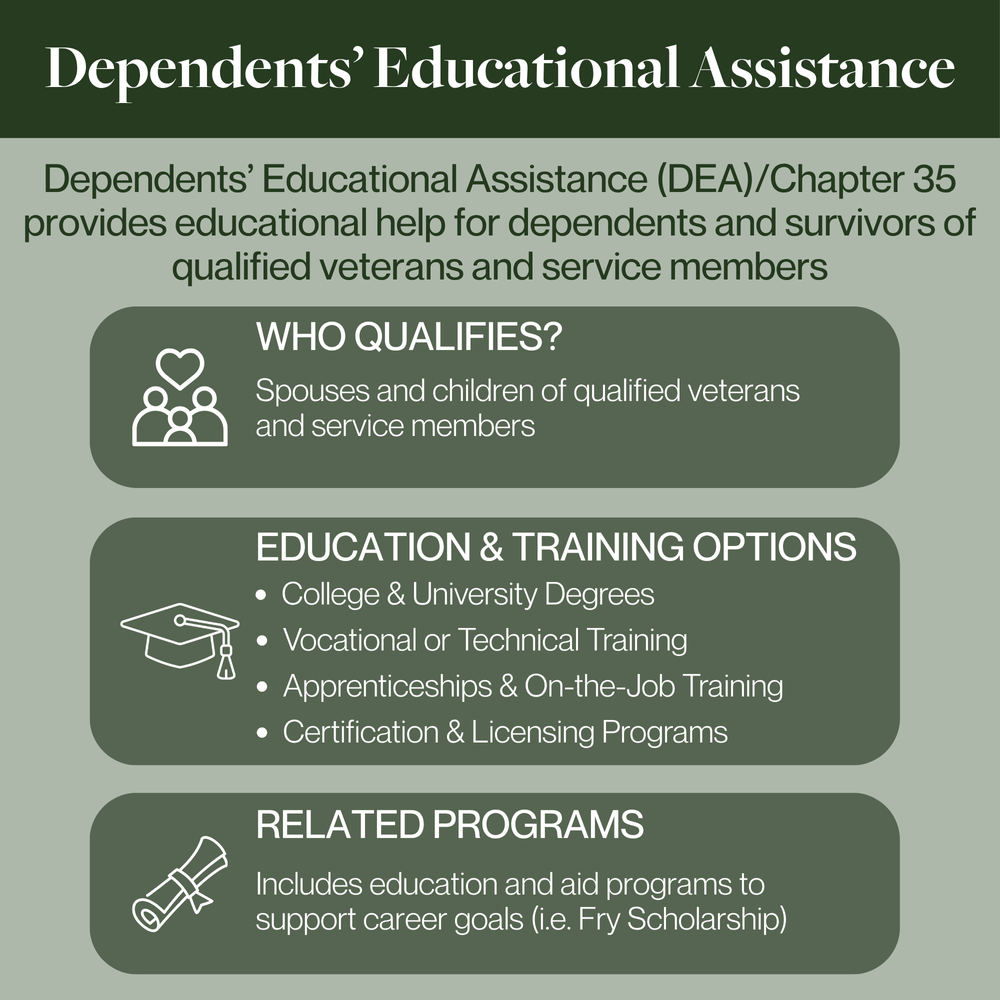
Dependents’ Educational Assistance (DEA), also known as Chapter 35 benefits, is a VA education program that provides financial support for schooling and training to eligible dependents of certain veterans. DEA benefits are most commonly available to spouses and children of veterans who are permanently and totally disabled due to service-connected conditions or who died as a result of service.

Because DEA eligibility is tied to a veteran’s disability status or cause of death—and subject to specific timing and usage rules—understanding how and when these benefits apply is critical for families seeking to use them.

Bottom Line Up Front:
  • DEA (Chapter 35) provides education benefits to eligible spouses and children of veterans who are permanently and totally disabled or deceased due to service-connected conditions.

  • Eligibility is most commonly triggered by a veteran being awarded Permanent and Total (P&T) status or by entitlement to Dependency and Indemnity Compensation (DIC).

  • Important to Know: DEA benefits have strict time limits for use, and missing those deadlines can result in loss of benefits.

 
What is Dependents’ Educational Assistance (DEA)?

DEA is governed by 38 U.S.C. Chapter 35 and provides monthly education benefits to eligible dependents for approved programs such as:

  • College or university degrees

  • Vocational or technical training

  • Apprenticeships and on-the-job training

  • Certification and licensing programs

DEA is not based on financial need. Instead, eligibility depends on the veteran’s service-connected disability status or cause of death.

Who is Eligible for DEA?

A spouse may qualify if the veteran:

  • Is rated permanently and totally disabled due to service-connected conditions, or

  • Died as a result of a service-connected disability, or

  • Died while permanently and totally disabled

Spouses may also qualify in certain cases involving missing, captured, or detained service members.

A child may qualify if the veteran meets the criteria above.

Eligibility is generally structured as follows:

  • Benefits typically begin at age 18 or upon completion of high school

  • Children generally have an 8-year period of eligibility to use DEA benefits

  • In some cases, the eligibility period may be extended based on specific circumstances

When Does DEA Eligibility Begin?

DEA eligibility is typically triggered by one of the following:

  • A VA decision granting Permanent and Total (P&T) disability status

  • A VA decision granting service connection for cause of death

  • A finding that the veteran was permanently and totally disabled at the time of death

In many cases, DEA eligibility is awarded automatically when VA grants P&T status. For a detailed discussion of Permanent and Total Status, please click here.

How Long Do You Have to Use DEA Benefits?

DEA benefits are subject to strict time limits.

  • Benefits generally begin at age 18 or upon completion of high school

  • Children typically have an 8-year period of eligibility to use benefits

  • Extensions may apply in certain circumstances

  • If based on P&T: generally 10 years from the date of eligibility

  • If based on a veteran’s death: generally 10 years from the date of death or VA decision

Some spouses may qualify for extended or modified eligibility periods depending on when the qualifying event occurred.

Evidence That Matters in DEA Claims

DEA eligibility is generally determined based on the veteran’s VA disability status, but documentation may still be required.

Key Evidence Includes:

  • VA rating decisions showing P&T status

  • Death certificates, in certain cases

  • VA decisions establishing service connection for cause of death

  • Proof of relationship (marriage or birth records)

Because DEA is derivative of the veteran’s benefits, errors in the underlying VA decision can directly impact eligibility.

What If VA Says a Dependent Is Not Eligible for DEA?

If VA determines that a dependent is not eligible for DEA, the issue is often tied to the underlying VA decision (such as P&T status or cause of death).

Those decisions may be challenged through:

  • Supplemental Claim (with new and relevant evidence)

  • Higher-Level Review

  • Board of Veterans’ Appeals

Because DEA eligibility is based on these underlying determinations, successfully appealing them may establish entitlement to DEA benefits.

Questions About DEA Benefits? Call Greene & Marusak LLC

DEA benefits are closely tied to a veteran’s disability status and VA’s legal determinations. Errors in those decisions can prevent families from accessing important educational benefits.

Here at Greene & Marusak, we are happy to answer general questions and help you understand how DEA eligibility may relate to a veteran’s underlying VA benefits.

Contact us today to speak with an experienced VA-accredited claims agent or attorney.

The PACT Act Explained

The Sergeant First Class Heath Robinson Honoring Our Promise to Address Comprehensive Toxics (PACT) Act is a landmark law that significantly expanded VA benefits for veterans exposed to toxic substances during service. Signed into law on August 10, 2022, the PACT Act affects veterans of the Vietnam, Gulf War, and post-9/11 eras by expanding presumptions, eligibility, and access to care.

Because toxic exposure claims often involve complex medical and legal issues—particularly proving exposure and nexus—the PACT Act plays a critical role in simplifying entitlement for many veterans.

Bottom Line Up Front:
  • The PACT Act added numerous presumptive conditions for burn pits, Agent Orange, and other toxic exposures.

  • Veterans who meet service requirements for presumptive exposure do not need to prove a medical nexus.

  • Important to Know: VA must now provide toxic exposure screenings to veterans enrolled in VA healthcare.

What Is a Presumptive Condition for Toxic Exposure?

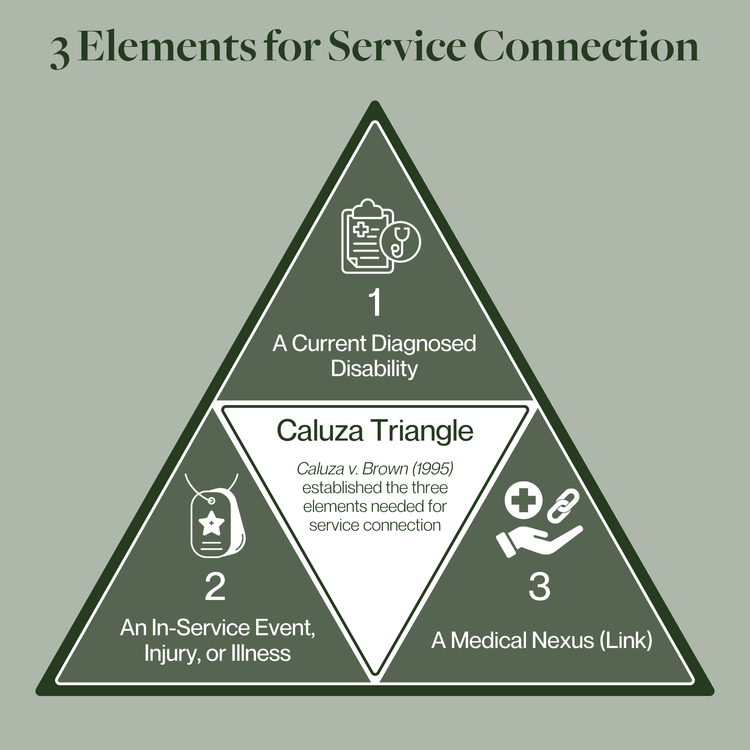
To establish service connection, veterans generally must show:

  • A current disability

  • An in-service event or exposure

  • A medical nexus linking the condition to service

This is called direct service connection. However, for presumptive conditions, VA automatically presumes the condition is related to service if the veteran meets specific service requirements. This is called presumptive service connection.

This means:

  • The veteran does not need to prove a medical nexus

  • The focus shifts to proving qualifying service and diagnosis

Who Qualifies Under the PACT Act?

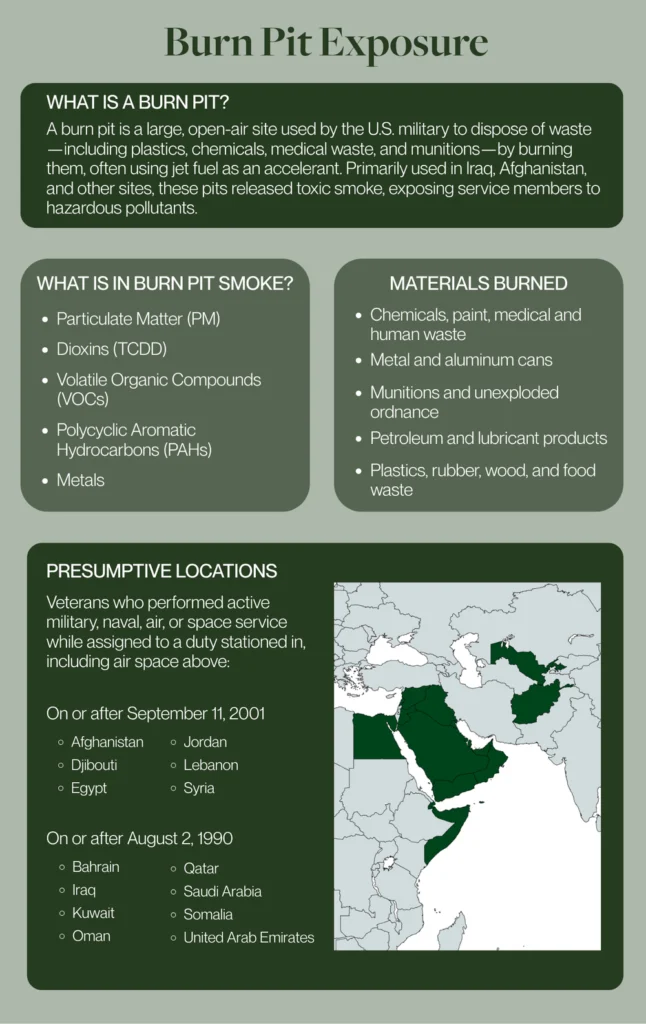
Veterans may qualify for presumptive exposure if they served:

On or after September 11, 2001, in:

  • Afghanistan

  • Djibouti

  • Egypt

  • Jordan

  • Lebanon

  • Syria

  • Uzbekistan

  • Yemen

  • The airspace above these locations

On or after August 2, 1990, in:

  • Bahrain

  • Iraq

  • Kuwait

  • Oman

  • Qatar

  • Saudi Arabia

  • Somalia

  • The United Arab Emirates (UAE)

  • The airspace above these locations

Veterans may qualify if they served:

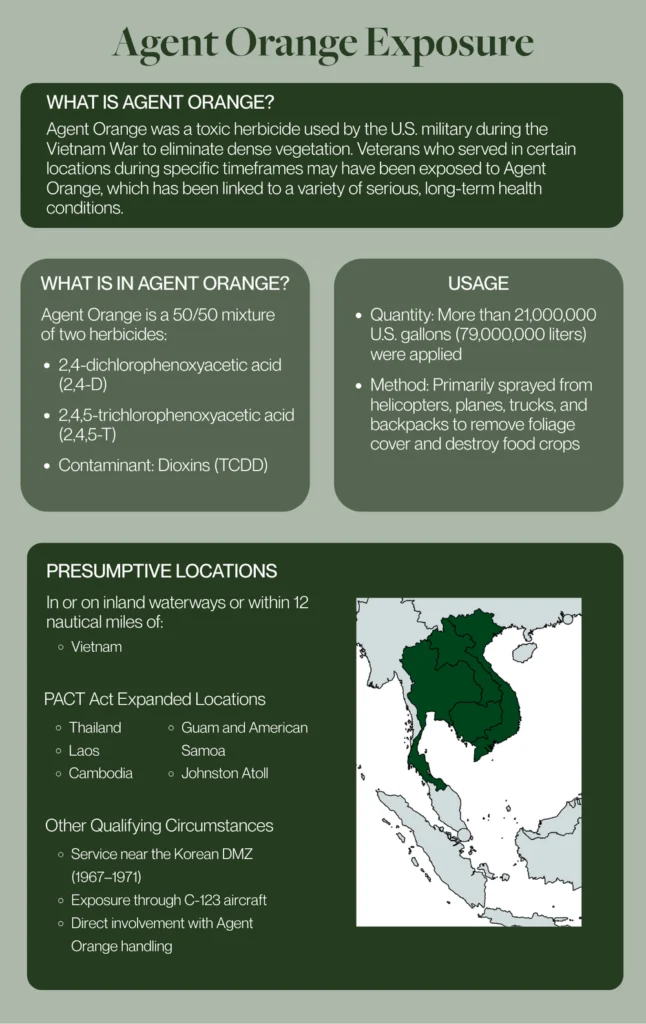
  • In the Republic of Vietnam

  • On inland waterways or within 12 nautical miles of Vietnam

The PACT Act also expanded qualifying locations to include:

  • Thailand (certain bases)

  • Laos

  • Cambodia (specific regions)

  • Guam and American Samoa

  • Johnston Atoll

Additional qualifying circumstances include:

  • Service near the Korean DMZ (1967–1971)

  • Exposure through C-123 aircraft

  • Direct involvement with Agent Orange handling

What Conditions Are Presumptive Under the PACT Act?

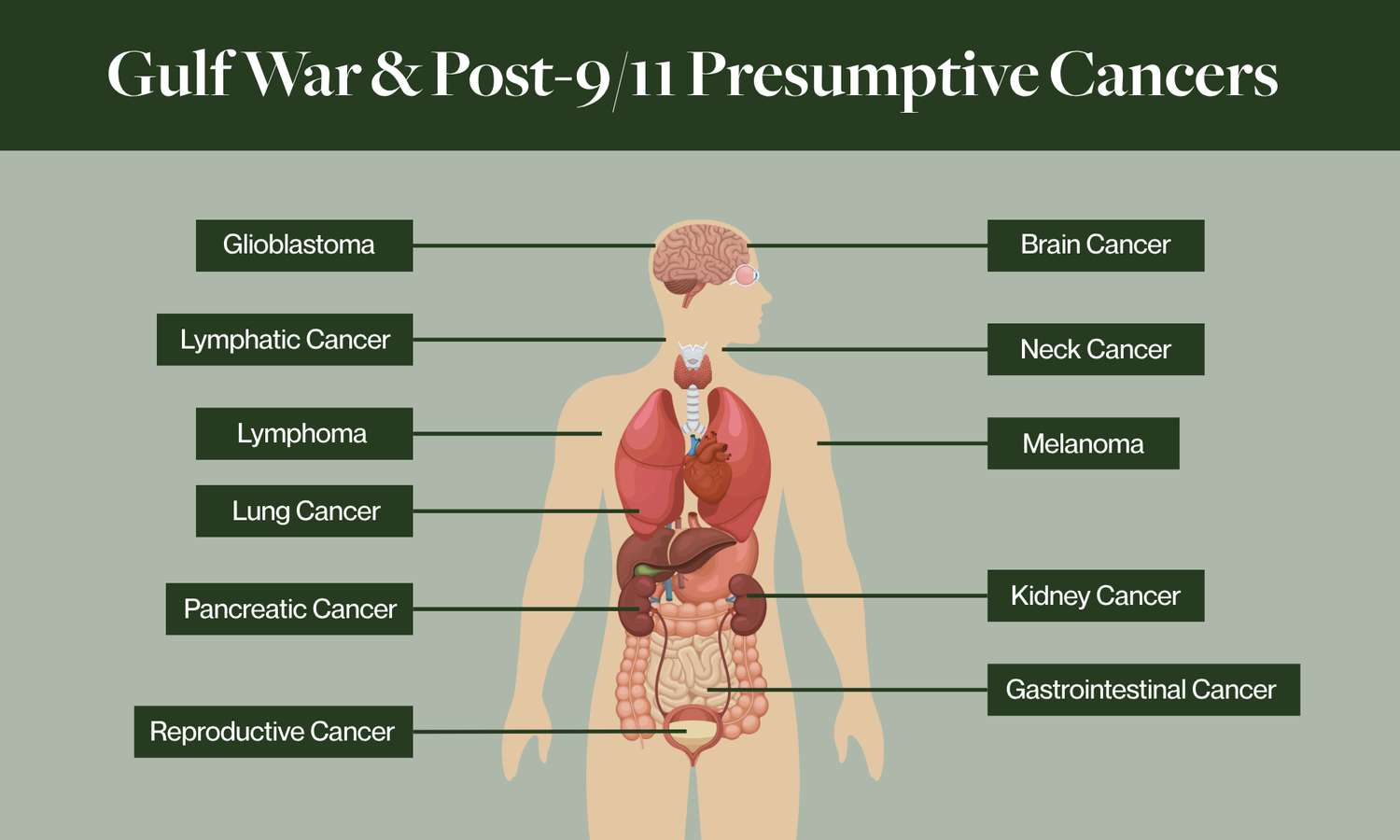
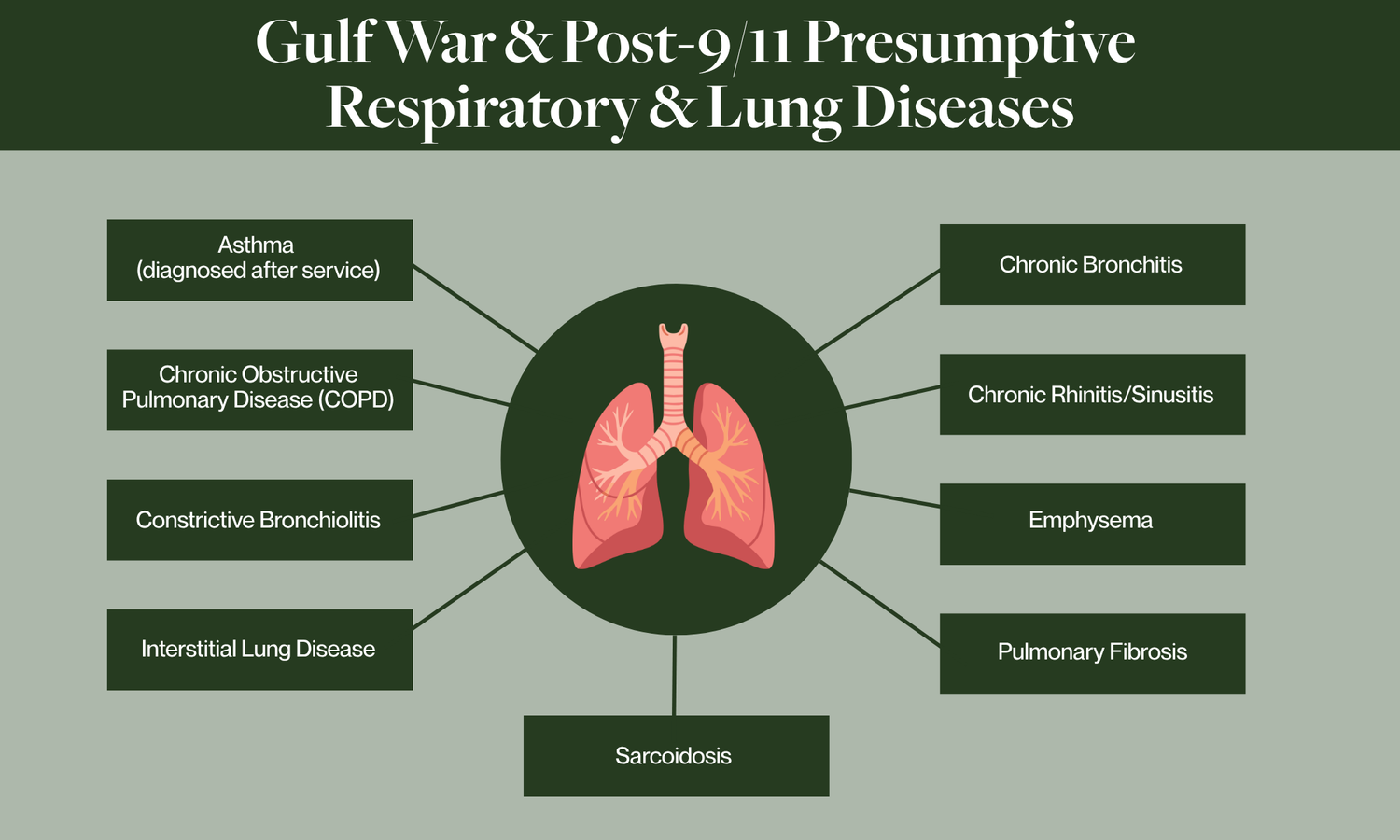
Under the PACT Act, VA presumes certain conditions are caused by exposure to burn pits and other airborne hazards for veterans who served in qualifying locations during the Gulf War and post-9/11 eras.

These presumptions apply only if the veteran meets the applicable service requirements described above.

Cancers include:

  • Brain cancer

  • Gastrointestinal cancers

  • Glioblastoma

  • Head cancer

  • Neck cancer

  • Kidney cancer

  • Pancreatic cancer

  • Reproductive cancers

  • Melanoma

  • Lymphoma

  • Respiratory cancers

Respiratory and related conditions include:

  • Asthma (diagnosed after service)

  • Chronic bronchitis

  • COPD

  • Chronic rhinitis and sinusitis

  • Constrictive bronchiolitis

  • Emphysema

  • Interstitial lung disease

  • Pulmonary fibrosis

  • Sarcoidosis

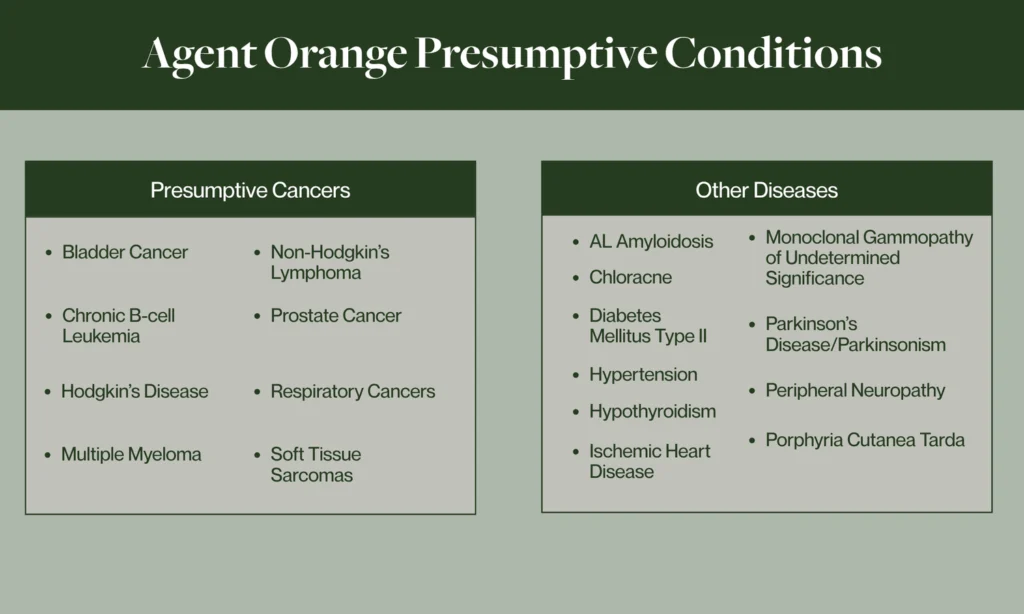
Under the PACT Act and existing VA law, certain conditions are presumed to be caused by exposure to Agent Orange and other herbicides for veterans who served in qualifying locations during the Vietnam era.

These presumptions apply only if the veteran meets the applicable service requirements described above.

  • Bladder cancer

  • Chronic B-cell leukemia

  • Hodgkin’s disease

  • Multiple myeloma

  • Non-Hodgkin’s lymphoma

  • Prostate cancer

  • Respiratory cancers (including lung cancer)

  • Some soft tissue sarcomas (excluding osteosarcoma, chondrosarcoma, Kaposi’s sarcoma, and mesothelioma)

  • AL amyloidosis

  • Chloracne (or similar acneform disease)

  • Diabetes mellitus type II

  • Hypothyroidism

  • Ischemic heart disease

  • Parkinson’s disease and Parkinsonism

  • Peripheral neuropathy (early onset)

  • Porphyria cutanea tarda

  • Hypertension (high blood pressure) (added by the PACT Act)

  • Monoclonal gammopathy of undetermined significance (MGUS) (added by the PACT Act)

Evidence That Matters in PACT Act Claims

Although presumptions reduce the burden of proof, strong evidence is still critical. 

  • DD-214 and personnel records showing qualifying service locations and dates

  • Unit records or deployment history

  • Current diagnosis of a presumptive condition

  • VA or private treatment records

  • Medical opinions (in complex or borderline cases)

  • Statements describing exposure circumstances

  • Symptom onset and progression

  • Functional impact of the condition

How to Appeal a Denied PACT Act Claim

If VA denies a claim related to toxic exposure or presumptive conditions, veterans may appeal through:

  • Supplemental Claim (with new and relevant evidence)

  • Higher-Level Review

  • Board of Veterans’ Appeals

Looking for More Information?

Check out our YouTube video where VA-Accredited Attorneys and Partners Jon Greene and Dan Marusak discuss the significance of the PACT Act for veterans.

Denied Benefits Under the PACT Act or Unsure If You Qualify? Call Greene & Marusak LLC

Toxic exposure claims are among the most complex areas of VA law. Veterans often face denials that overlook critical evidence or misapply the law.

If VA denied your PACT Act-related claim—or you are unsure whether you qualify—Greene & Marusak LLC can review your case and explain your options.

Contact us for a free case evaluation today to speak with an experienced VA-accredited claims agent or attorney.
Permanent and Total (P&T) Disability Status Explained

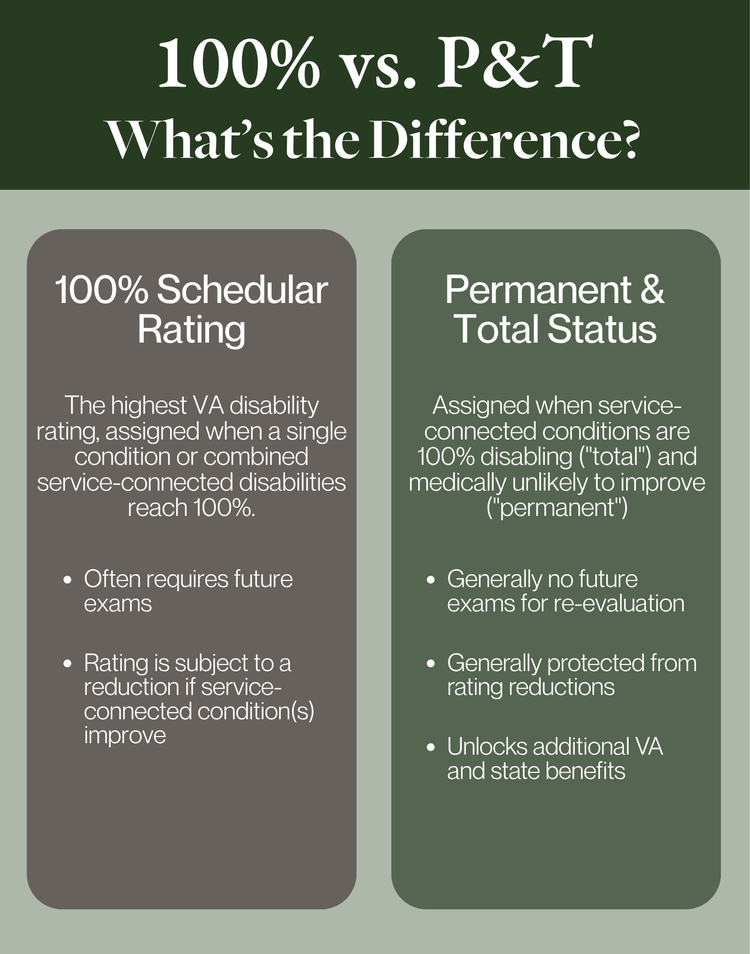
Permanent and Total (P&T) disability status is an important designation in VA benefits law that may be awarded when a veteran is totally disabled and VA determines the condition is unlikely to improve. While P&T status does not increase a veteran’s monthly compensation, it can unlock significant additional benefits for both the veteran and their dependents. Because VA does not always clearly communicate when P&T has been granted—or how to obtain it—understanding the criteria and process is essential.

Bottom Line Up Front:
  • P&T status is granted when a veteran is rated totally disabled (100% or TDIU) and VA determines their condition is unlikely to improve.

  • Medical evidence showing permanence is critical to obtaining P&T status.

  • Important to Know: P&T is not a separate claim with a standard form, but it can be requested or pursued as part of an appeal.

What is Permanent and Total Disability Status?

P&T status applies when:

  • A veteran is rated 100 percent disabled (schedular), or

  • A veteran is awarded total disability based on individual unemployability (TDIU), and

  • VA determines the veteran’s service-connected disabilities are reasonably certain to continue throughout their lifetime without improvement.

A P&T finding is not a new benefit, it’s a designation. Unlike standard disability ratings, P&T status reflects a finding of permanence. This means VA believes the severity of the condition will not materially improve, and as a result, the veteran’s rating is considered stabilized.

Although P&T status does not result in additional monthly compensation, it provides access to a range of additional federal and state benefits.

What Are the Additional Benefits of P&T Status?

A veteran who has been awarded P&T status may be eligible to take advantage of additional VA and state benefits, including:

Additionally, another benefit of P&T status is that VA will generally no longer schedule examinations to reevaluate a Veteran’s disabilities because the P&T status represents a determination that improvement is unlikely.

How to Request or Appeal P&T Status

Veterans who are rated 100 percent or receiving TDIU may request P&T status if their condition is unlikely to improve. Because VA does not always grant P&T automatically, it often must be affirmatively pursued.

Unlike most VA claims, there is no standardized form required. Veterans may submit a written request to VA asking for P&T status and include medical evidence demonstrating that their service-connected disabilities are permanent.

P&T status may also be pursued as part of a review of a rating decision. For example, if VA grants a 100 percent rating or TDIU but does not find the condition permanent, the veteran may seek P&T through:

  • Supplemental Claim (with new and relevant evidence)

  • Higher-Level Review

  • Board of Veterans’ Appeals

Because P&T determinations often hinge on medical evidence and VA’s interpretation of permanence, strong legal and medical support can significantly improve the likelihood of success.

How Do You Know if VA Has Awarded P&T Status?

VA does not always clearly state when P&T status has been awarded. However, one of the most common indicators appears in the rating decision or notification letter:

  • “Basic eligibility to Dependents’ Educational Assistance based on permanent and total disability status is established.”

If this language is included, VA has granted P&T status.

If the decision is unclear, veterans can:

  • Request a VA benefits summary letter, or

  • Contact VA directly to confirm whether P&T status has been awarded

Looking for More Information?

Check out our YouTube video where VA-Accredited Claims Agents Vittoria Marini and VA-Accredited Attorney Courtney Ross discuss the meaning of Permanent and Total (P&T) disability status for veterans.

Interested in Pursuing Total Disability to Obtain P&T Status? Call Greene & Marusak LLC

VA does not always properly evaluate whether a veteran’s condition is permanent. Many veterans who qualify for P&T status are never awarded it due to lack of development or misapplication of the law.

If VA denied P&T status—or you are unsure whether you qualify—Greene & Marusak LLC can review your case and explain your options.

Contact us for a free case evaluation today to speak with an experienced VA-accredited claims agent or attorney.
Service Connection Explained

Service connection is the foundation of nearly all VA disability compensation claims. It is the legal determination that a veteran’s current disability was caused or aggravated by military service. Establishing service connection often requires navigating service records, medical evidence, and VA regulations. Because service connection determines eligibility for monthly compensation, healthcare, and other benefits, properly developing the claim is critical.

Bottom Line Up Front:
  • The most common type of service connection (direct service connection) requires three core elements: a current disability, an in-service event or exposure, and a medical nexus linking the two.

  • Medical records, nexus opinions, and credible lay evidence are often critical to establishing entitlement.

  • Important to Know: Service connection may be established through multiple legal theories, including direct, secondary, presumptive, or aggravation.

What is Service Connection?

Service connection is governed primarily by 38 U.S.C. §§ 1110, 1131 and 38 C.F.R. §§ 3.303–3.310. The most common path to service connection is direct service connection, which requires evidence of the following three elements:

  • A current diagnosed disability

  • An in-service event, injury, disease, or exposure

  • A nexus establishing the condition is “at least as likely as not” related to service

These three elements form the foundation of direct service connection claims. However, VA also recognizes alternative paths to service connection, such as secondary, presumptive, and aggravation-based theories.

VA claims are decided under the “benefit of the doubt” standard. When the evidence is in approximate balance, VA must resolve reasonable doubt in favor of the veteran.

The Ways to Establish Service Connection

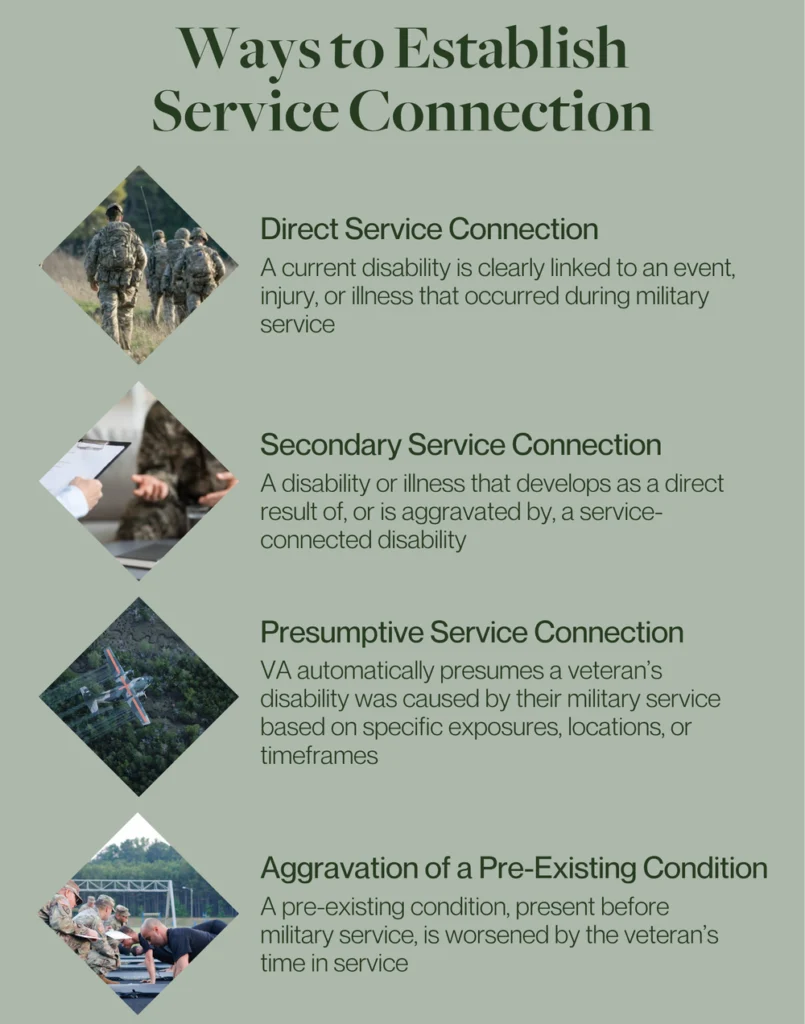
VA recognizes several paths to service connection, depending on how the condition is related to service:

The most common type of service connection. Under this type, a disability began during service or was directly caused by an in-service event, injury, or exposure. Evidence may include:

  • Service treatment records

  • Deployment or exposure records

  • VA or private medical evaluations

  • Nexus opinions linking the condition to service

  • Lay statements describing in-service events and resulting symptoms

A disability is caused or aggravated by another service-connected condition. Examples include:

  • Sleep apnea secondary to PTSD

  • Radiculopathy secondary to a back condition

  • Depression secondary to chronic pain

  • Peripheral neuropathy secondary to diabetes mellitus

Certain conditions are presumed to be related to service based on specific exposures, locations, or timeframes. Common types include:

  • Agent Orange and herbicide exposure

  • Gulf War undiagnosed or chronic multi-symptom illnesses

  • Burn pit and toxic exposures under the PACT Act

  • Certain chronic conditions manifesting within one year of discharge

If a veteran entered service with a pre-existing condition that permanently worsened beyond its natural progression during service, VA must grant service connection for the degree of aggravation. Examples include:

  • A veteran enters service with pre-existing asthma, which becomes significantly worse due to in-service environmental exposures

  • A veteran with a pre-existing knee condition experiences permanent worsening due to the physical demands of military training

  • A veteran with a pre-existing mental health condition that is permanently aggravated by traumatic in-service experiences

 
Evidence That Matters Most in Service Connection Claims

Strong medical documentation is essential, including:

  • VA and private treatment records

  • VA examinations

  • Diagnostic testing

  • Independent medical examinations (IMEs) or nexus letters

  • Specialist evaluations linking the condition to service

A well-reasoned nexus opinion applying the “at least as likely as not” standard is often the most important piece of evidence

Lay statements from the veteran, family members, friends, or fellow service members can establish:

  • In-service symptoms or events not documented in service records

  • Continuity of symptoms from service to the present

  • The functional impact of the condition

Lay evidence is especially important when records are incomplete or when symptoms were not formally documented during service.

Common Reasons VA Denies Service Connection

VA frequently denies claims based on:

  • Lack of a current diagnosis

  • No documented in-service event or exposure

  • Inadequate or negative VA medical opinions

  • Lack of continuity of symptoms

  • Incomplete or missing service records

Many claims are initially denied but later granted when stronger evidence is submitted on appeal.

How to Appeal a Denied Service Connection Claim

If VA denies service connection, veterans may appeal through:

  • Supplemental Claim (with new and relevant evidence)

  • Higher-Level Review

  • Board of Veterans’ Appeals

Because service connection claims often hinge on medical causation and proper application of VA regulations, professional representation can significantly improve outcomes.

Looking for More Information?

Check out our YouTube video where VA-Accredited Attorneys, Daniel Marusak and Courtney Ross, and VA-Accredited Claims Agent, Vittoria Marini, sit down to discuss the ins and outs of service connection for disabled veterans.

Denied Service Connection or Unsure If You Qualify? Call Greene & Marusak LLC

Service connection is the foundation of all VA disability benefits—but it is also one of the most frequently contested issues. Veterans are often denied due to incomplete evidence, inadequate medical opinions, or errors in applying the law.

If VA denied your service connection claim—or you need help developing the right medical and legal evidence—Greene & Marusak LLC can review your case and explain your options.

Contact us for a free case evaluation today to speak with an experienced VA-accredited claims agent or attorney.
Special Monthly Compensation (SMC) Explained

SMC Special Monthly Compensation (SMC) is an additional level of VA disability compensation available to veterans with severe service-connected disabilities. Unlike standard disability ratings (0–100%), SMC provides higher compensation based on specific types of impairment, such as loss of use of extremities, severe sensory disabilities, or the need for regular aid and attendance.

Because SMC is governed by complex statutory and regulatory rules—and often overlooked by VA—understanding eligibility and properly developing the claim is critical.

Bottom Line Up Front:
  • SMC provides compensation above the standard 100% rate for veterans with severe disabilities or special circumstances.

  • Eligibility depends on specific criteria, including loss of use, aid and attendance, or combinations of disabilities.

  • Important to Know: VA is required to consider SMC when raised by the record, but often fails to do so correctly.

What is Special Monthly Compensation (SMC)?

SMC is governed primarily by 38 U.S.C. § 1114 and 38 C.F.R. § 3.350 and provides increased compensation for veterans whose service-connected disabilities result in:

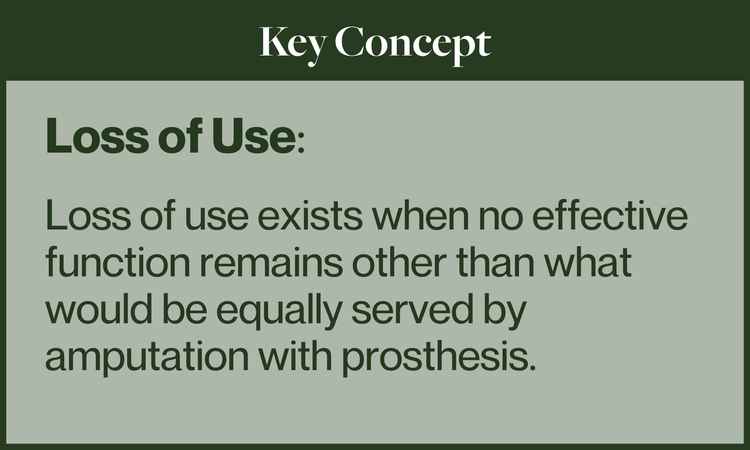
  • Loss or loss of use of extremities

  • Severe visual or hearing impairment

  • The need for regular aid and attendance

  • Housebound status

  • Combinations of disabilities creating greater levels of impairment

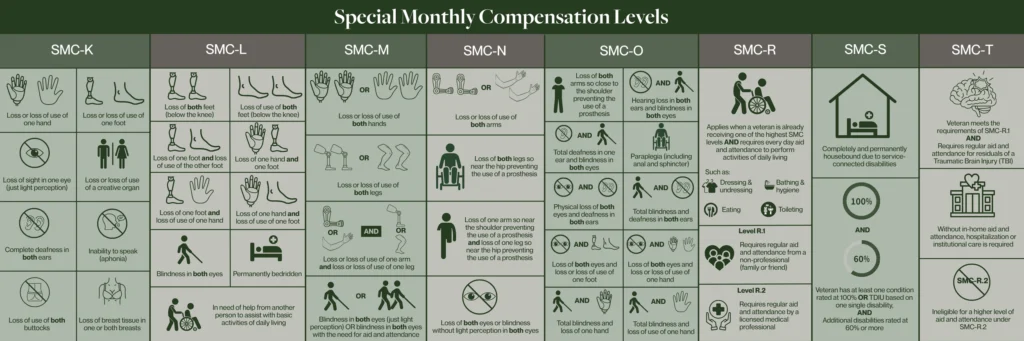
SMC is paid at different levels, identified by letters (SMC-K through SMC-T), depending on the severity and type of disability.

Understanding SMC Levels

SMC levels correspond to subsections of 38 U.S.C. § 1114.

  • Most SMC levels replace the standard compensation rate

  • SMC-K is unique because it is paid in addition to the base rate

  • Some levels can be combined or “stacked” depending on the circumstances

The levels are as follows (in alphabetical order / order in 38 U.S.C. § 1114):

SMC-K is awarded for loss or loss of use of specific body parts or functions, including:

  • One hand or foot

  • Creative organs

  • One eye (limited vision)

  • Complete deafness in both ears

  • Loss of breast tissue (in certain cases)

A veteran may receive multiple SMC-K awards, which are added to the base compensation rate.

SMC-L may be awarded for:

  • Loss of use of both feet or one hand and one foot

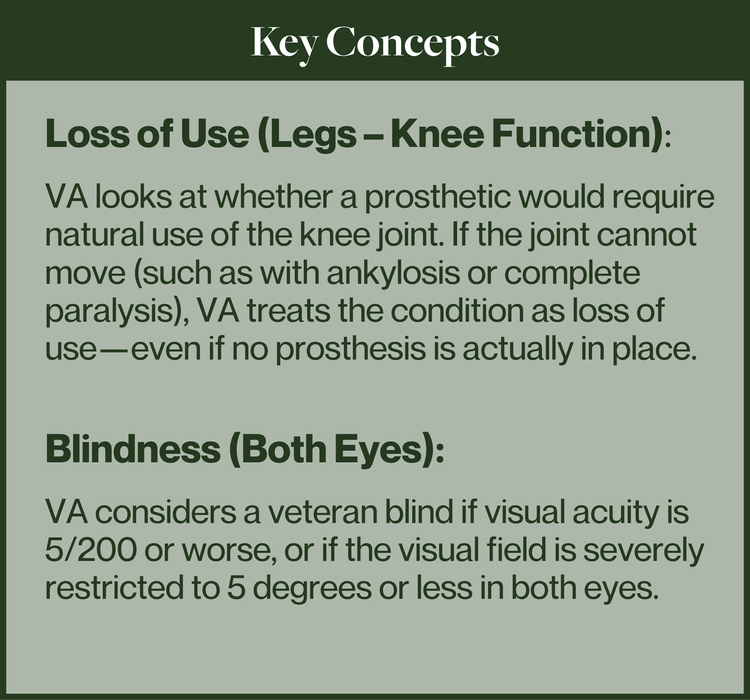
  • Severe blindness

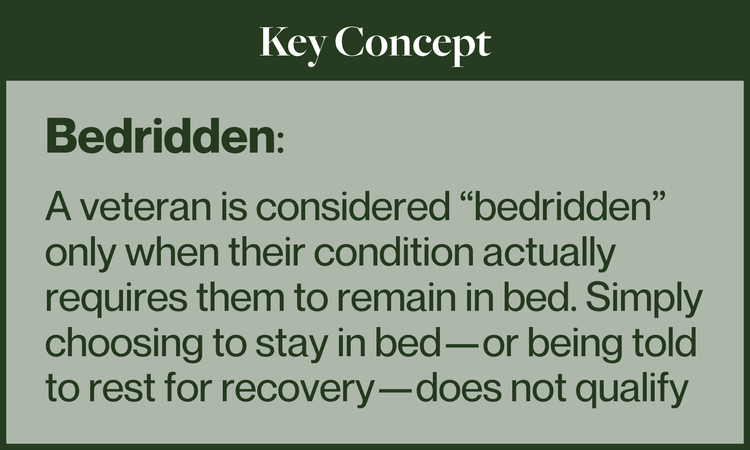
  • Being permanently bedridden

  • Need for regular aid and attendance

In practice, this level is most commonly awarded based on aid and attendance.

VA considers factors such as:

  • Inability to dress, bathe, or maintain hygiene

  • Inability to feed oneself

  • Inability to attend to toileting

  • Need for assistance to avoid daily hazards

In our practice, we most often see SMC-L awarded based on the need for regular aid and attendance. For a detailed discussion of aid and attendance, please click here.

These higher levels apply to progressively more severe disabilities, including combinations such as:

  • Loss of use of multiple extremities

  • Severe blindness

  • Combinations of disabilities affecting mobility and independence

SMC-O may also be awarded when a veteran qualifies for multiple SMC levels (L through N) based on separate disabilities.

Important Note on Combining SMC Levels: To qualify for higher SMC levels based on multiple conditions, those conditions must be separate and distinct. In other words, you cannot use the same disability twice to qualify for a higher level of SMC. For example, if a veteran’s loss of use of both legs is the reason they also need aid and attendance, VA will not count those as two separate qualifying conditions.

SMC-P provides intermediate increases (“half-step” or “full-step”) between levels when:

  • A veteran has additional independent disabilities rated at 50% or 100%

  • The disabilities are separate and affect different body systems

These increases can stack, but cannot exceed the SMC-O rate.

SMC-R applies when a veteran is already receiving one of the highest SMC levels and:

  • Requires regular aid and attendance (SMC-R.1), or

  • Requires a higher level of care (SMC-R.2)

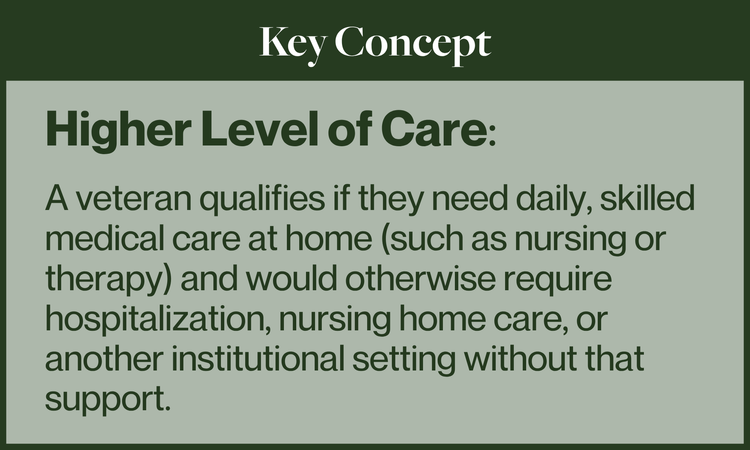
A higher level of care means the veteran would otherwise require institutional care (e.g., nursing home) without daily skilled assistance.

SMC-S may be awarded when a veteran:

  • Has one disability rated at 100% or TDIU based on a single disability, and

  • Has additional disabilities rated at 60% or more, or

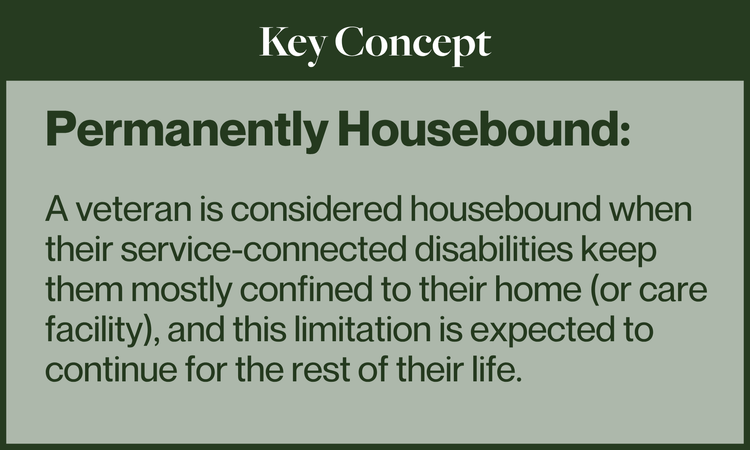
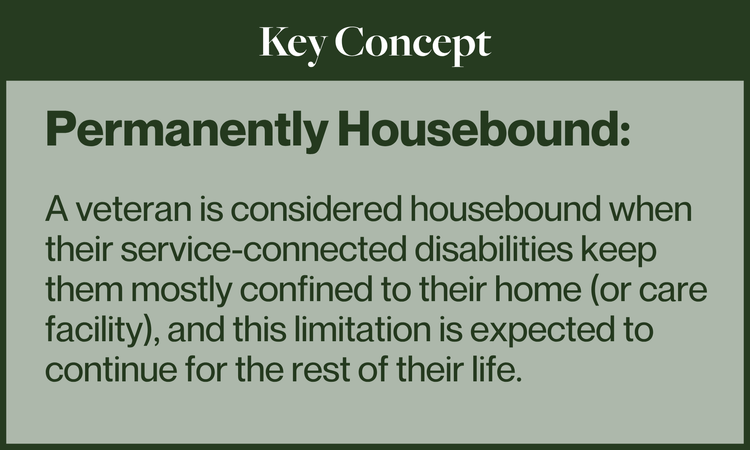
  • Is permanently housebound due to service-connected disabilities

For a more detailed discussion of SMC-S click here

SMC-T applies to veterans with traumatic brain injury (TBI) who:

  • Meet the minimum requirements of SMC-R.1

  • Require regular aid and attendance

  • Would otherwise require institutional care

  • Do not qualify for SMC-R.2

Evidence That Matters Most in SMC Claims

Strong medical documentation is critical, including:

  • VA Form 21-2680 (Aid and Attendance examination)

  • VA and private treatment records

  • Medical opinions addressing functional limitations and care needs

In many cases, a private medical opinion is necessary to support entitlement or challenge a VA denial.

Lay statements can establish:

  • The veteran’s daily limitations

  • Need for assistance with activities of daily living

  • Level of supervision or care required

Lay evidence is especially important when medical records do not fully reflect the severity of the disability.

How to Appeal a Denied SMC Claim

If VA denies SMC, Veterans may appeal through:

  • Supplemental Claim (with new and relevant evidence)

  • Higher-Level Review

  • Board of Veterans’ Appeals

Because SMC claims involve complex statutory interpretation and detailed medical evidence, professional representation can significantly improve outcomes.

Denied SMC or Unsure If You Qualify? Call Greene & Marusak LLC

SMC claims are among the most complex areas of VA law. Veterans often face denials that overlook critical evidence or misapply the law.

If VA denied your SMC claim—or you are unsure whether you qualify—Greene & Marusak LLC can review your case and explain your options.

Contact us for a free case evaluation today to speak with an experienced VA-accredited claims agent or attorney.
Special Monthly Compensation (SMC-S) Based on Housebound Status Explained

VA disability ratings generally range from 0% to 100%. However, VA recognizes that even a 100% rating may not fully reflect a veteran’s level of impairment. In these cases, veterans may be entitled to additional compensation above the standard rates, known as Special Monthly Compensation (SMC).

SMC-S, or “housebound” benefits, is awarded when a veteran has severe service-connected disabilities that either meet specific rating thresholds or substantially confine them to their home.

Bottom Line Up Front:
  • SMC-S provides compensation above the standard 100% rate for veterans with severe disabilities that significantly limit their ability to leave home.

  • Eligibility is based on either statutory housebound criteria (ratings-based) or being housebound-in-fact (actual confinement) due to service-connected disabilities.

  • Important to Know: SMC-S is often overlooked. Many veterans qualify without realizing it, especially those with TDIU or multiple high ratings.

What is SMC-S (Housebound)?

SMC-S is governed by 38 C.F.R. § 3.350(i) and may be awarded when a veteran has:

  • A single service-connected disability rated at 100%, and

  • Either:

    • Additional service-connected disabilities independently rated at 60% or more, separate and distinct, or

    • Is permanently housebound due to service-connected disabilities

For a detailed discussion of all levels of Special Monthly Compensation click here

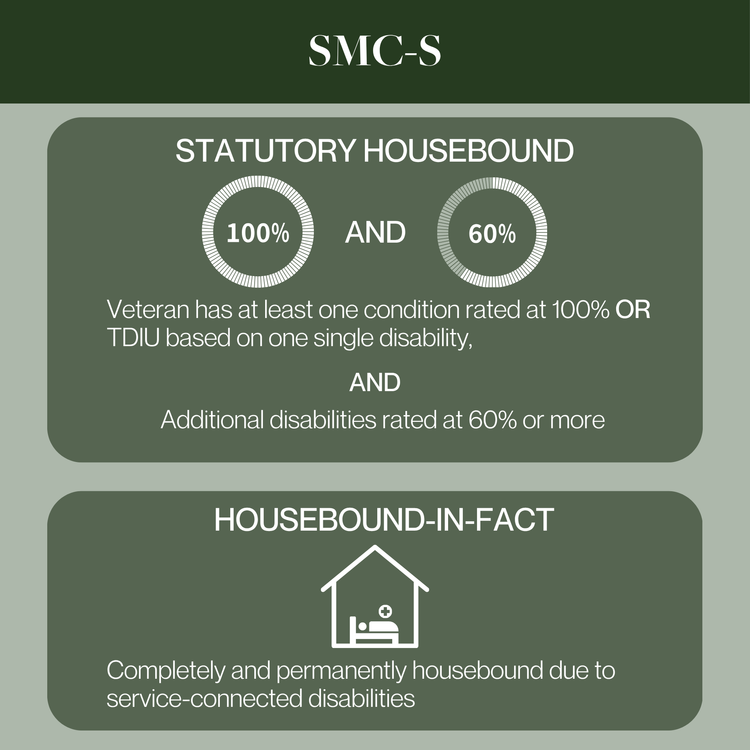
Two Paths to SMC-S

1) Statutory Housebound (Ratings-Based)

A veteran qualifies when:

  • One disability is rated at 100% (including TDIU based on a single disability), and

  • Additional disabilities combine to at least 60% and are separate from the 100% condition

2) Housebound-in-Fact

A veteran qualifies when their service-connected disabilities substantially confine them to their home or care facility.  

Important Considerations
  • A TDIU award based on a single disability can satisfy the 100% requirement for SMC-S

  • Disabilities used to meet the 60% requirement must be separate and distinct from the 100% condition

  • VA is required to consider SMC-S automatically when the evidence supports it—even if the veteran did not specifically claim it

Important Evidence That Matters in SMC Claims

Strong medical documentation is critical, including:

  • VA Form 21-2680 (Examination for Housebound Status or Aid and Attendance)

  • VA and private treatment records

  • Records from care facilities or in-home care providers

Medical evidence should address the severity of the condition and its impact on the veteran’s ability to leave the home.

Lay statements can provide critical insight into the veteran’s daily life, including:

  • How often the veteran leaves the home (if at all)

  • Physical or mental limitations that prevent leaving

  • Need for assistance with mobility, transportation, or daily activities

Lay evidence is especially important because medical records often do not capture:

  • The effort required to leave the home

  • Symptoms triggered by leaving (pain, panic, fatigue)

  • The frequency with which the veteran remains confined

How to Appeal a Denied SMC-S Claim

If VA denies SMC-S, Veterans may appeal through:

  • Supplemental Claim (with new and relevant evidence)

  • Higher-Level Review

  • Board of Veterans’ Appeals

Because SMC-S is frequently overlooked or improperly analyzed by VA, appeals often focus on correcting legal errors or fully developing the evidence.

Denied SMC-S or Unsure If You Qualify? Call Greene & Marusak LLC

SMC claims are among the most complex areas of VA law. Veterans often face denials that overlook critical evidence or misapply the law.

If VA denied your SMC-S claim—or you are unsure whether you qualify—Greene & Marusak LLC can review your case and explain your options.

Contact us for a free case evaluation today to speak with an experienced VA-accredited claims agent or attorney.
Total Disability Rating Based on Individual Unemployability (TDIU) Explained

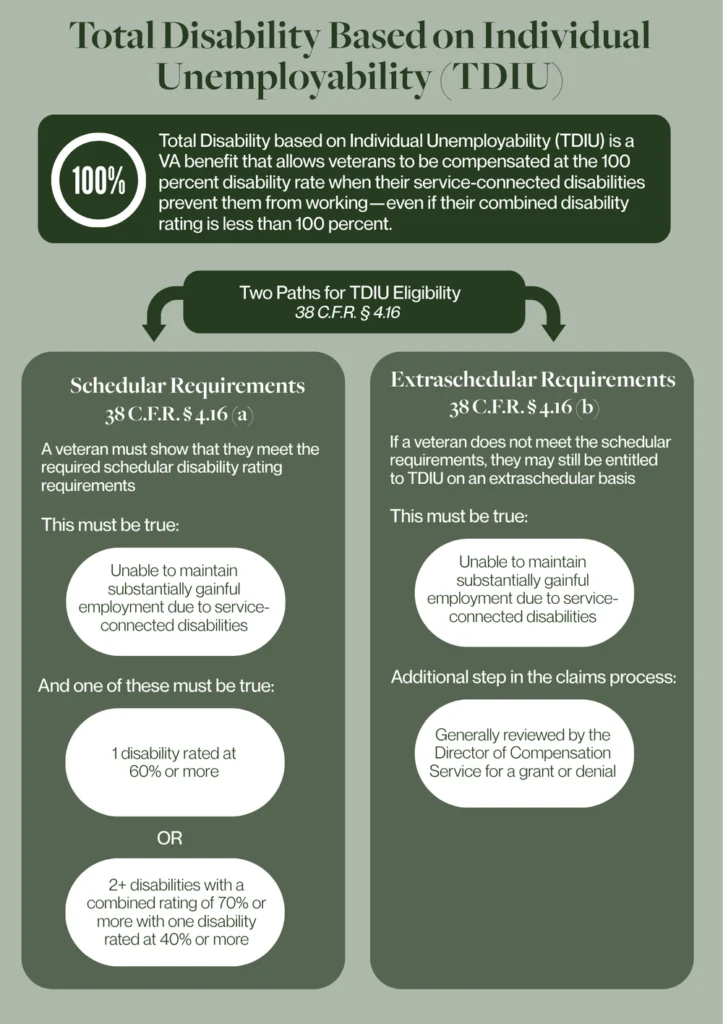
Total Disability based on Individual Unemployability (TDIU) is a VA benefit that allows veterans to be compensated at the 100 percent disability rate when their service-connected disabilities prevent them from working—even if their combined disability rating is less than 100 percent. Because TDIU focuses on a veteran’s ability to function in a work setting, these claims often require detailed medical and vocational evidence.

Bottom Line Up Front:
  • TDIU is granted when a veteran’s service-connected disabilities prevent them from securing or maintaining substantially gainful employment.

  • Substantially gainful employment generally means work that provides income above the federal poverty threshold for one individual.

  • Important to Know: TDIU can be awarded even if a veteran does not meet the standard combined rating requirements, depending on the severity of their disabilities and impact on employment.

What is TDIU?

TDIU is governed by 38 C.F.R. § 4.16 and provides compensation at the 100-percent pay rate when a veteran is unable to maintain substantially gainful employment due to service-connected disabilities.

VA recognizes two primary paths to TDIU:

A veteran may qualify if they have:

  • One service-connected disability rated at least 60 percent, or

  • Multiple service-connected disabilities with a combined rating of at least 70 percent, with at least one disability rated at 40 percent or higher

For purposes of meeting the “single disability” requirement, VA may combine certain conditions and treat them as one disability, including:

  • Disabilities affecting a single body system (e.g., orthopedic conditions)

  • Disabilities resulting from a common etiology or single incident

  • Disabilities affecting one or both upper or lower extremities

  • Multiple injuries incurred in action

  • Multiple disabilities incurred as a prisoner of war (POW)

Even if a veteran does not meet the percentage thresholds above, VA may still grant TDIU if the evidence shows the veteran is unable to secure or follow substantially gainful employment due to service-connected disabilities.

How VA Evaluates TDIU Claims

The central question in a TDIU claim is whether the veteran can perform substantially gainful employment—not just whether they can return to a prior job.


VA must consider:

  • The functional limitations caused by service-connected disabilities

  • The veteran’s education, training, and work history

  • Whether the veteran can realistically perform and sustain work

VA cannot consider:

  • The veteran’s age

  • Non-service-connected disabilities

Evidence That Matters Most in TDIU
  • VA Form 21-8940 (Veteran’s Application for Increased Compensation Based on Unemployability)

  • VA Form 21-4192 (Request for Employment Information)

  • Medical records documenting functional limitations

  • Vocational expert opinions addressing the veteran’s ability to work

  • Opinions linking service-connected disabilities to unemployability

  • Statements from the veteran, family members, or coworkers describing how disabilities impact daily functioning and the ability to work

  • Reports of missed work, reduced productivity, or job loss due to service-connected conditions

Strong evidence often focuses on how symptoms translate into real-world work limitations.

How to Appeal a Denied TDIU Claim

If VA denies entitlement to TDIU, veterans may appeal through:

  • Supplemental Claim (with new and relevant evidence)

  • Higher-Level Review

  • Board of Veterans’ Appeals

Because TDIU claims involve detailed analysis of medical evidence, vocational limitations, and VA regulations, professional representation can significantly improve outcomes.

Looking for More Information?

Check out our YouTube video where VA-Accredited Attorney, Jon Greene, and VA-Accredited Claims Agents, Vittoria Marini and John Kent, sit down to discuss everything veterans need to know about TDIU.

Denied TDIU or Unsure If You Qualify? Call Greene & Marusak LLC

TDIU claims are among the most complex areas of VA law. Veterans are often denied because VA fails to fully consider how their disabilities impact their ability to work.

If VA denied your TDIU claim—or you are unsure whether you qualify—Greene & Marusak LLC can review your case and explain your options.

Contact us for a free case evaluation today to speak with an experienced VA-accredited claims agent or attorney.